Project Recovery: It takes more than an experienced project manager to rescue a troubled project:
What’s most scarce at a project recovery is time. The Project Doctor must be able to ramp up extremely short-term. Affinity and understanding of the project context is key, industry expertise not necessarily. There are always nearly the same mistakes happening in all industries…
Project recovery is for absolute hands in the project management subject. They need deepest methodologic competence far beyond normal project management, i.e. not only knowledge but comprehension, and safe application of project and programme management and agile methods.
To quickly find effective measures for recovery it takes much experience in rescuing distressed projects: proficient identification of the main reasons and corresponding adequate measures.
At troubled projects often nerves are strained. To succeed the Project Doctor must bring along high leadership skills, knowledge of human nature and much empathy in Stakeholder Management.
This also involves distinct conflict resolution, moderation and mediation abilities.
Sometimes the devil or the agreement is in the detail. That’s why a good legal appreciation for contract set up and interpretation in the cultural context is an important asset for a Project Doctor and his client.
Projects in distress often require changes in many areas. Therefore a Project Doctor who is also an expert in Change, Supplier, Contract, and Claim Management is an advantage.
And finally a Project Doctor need a “solid back“, independence and readiness for confrontation. He must not fear “high-ups”.
You already lost enough money in your troubled project. Do it right this time, and acquire help from a real project recovery expert! He will always be more economical than a cheap solution…
In the first part of my article I have shown how particularly big companies and public authorities merely pre-program bad success, delays, and cost increases in their projects and investments by mistaken staffing of their Project Management positions. This second part is to look at the reasons why these troubled projects do not or insufficiently receive help to get back on track again there.
But how do companies and their responsible managers now deal with their “sub-optimal” project results, how do they react if their projects get into distress then? This is mainly dependent on the corporate leadership culture and structure. And it is the matter to decide on whether, when and how troubled projects get help.
Looking for the wrong causes at mid-size companies
In mid-size, owner-led companies the boss observes a long time; eventually he supports on the professional topics with his know how. On the other side there often lacks a “critical mass” to afford well trained (full time) project managers. The PMs mostly lead multiple projects in parallel, and on top they are intensively involved in other firm activities like pre-sales, technics and design, and administration.
Issues nearly always are suspected on the technical features, nearly never at the (project) management. Therefore the boss mostly waits for the break-through with an unchanged setup, or decides to cancel when sunk cost is getting too high: An immensely expensive self-healing or total write-off. The third alternative to change the setup, thus probably achieving some remaining return of investment in most cases is not on the radar due to a lack of openness for external solutions (“these guys do not know how our business goes”).
But there are also successful exceptions where the boss feels bad for the burned money, and lionhearted requests advice from external experts. If he does early enough there is mostly hope for project success and a gain of lessons for the future.
Phlegmatic corporations and public administrations
In huge firms with multiple hierarchy levels between general and work floor management we find other mechanisms. Project staffing often follows fixed processes, e.g. via procurement as described above. There is enough project management utilization for well-educated full time PMs. It depends on the industry whether they primarily have e.g. project engineers (technical industry) or project managers (service companies).
Whether the company puts invests into PM education and project support by the organization (and thus into quality and profitability of its project results) is a very individual question of project acknowledgement and strategic priorities on the executive level.
If projects get into distress in those companies the reaction is dependent on the corporate culture. In much segmented organizations problems are often kept covered as long as possible while developing a “career neutral” exit strategy. Usually a scape goat is found, and they continue with the same means which led into crisis, until superior levels get alert and stop the project. In such companies the cancellation rate is significantly higher than the number of attempts to recover troubled projects. They produce the majority of project failure and cancellations in the statistics, but not because of unavailable means for recovery, but due to fear of transparence and lack of management attention.
Similar behavior patterns can be found in nearly all projects at public administration. At project setup and solicitation highest emphasis is put on keeping to processes (e.g. VOB, HOAI etc.). Project management often is assigned as part of the trade or craft; there is no control at the principal left due to lacking competence. Why ever? According to a statement of a well-known Berlin politician plan overriding by 30% is “absolutely normal”! A self-fulfilling prophecy that can repeatedly be topped…
Hope dies last
There is hope especially at mid-size or big companies whose „flat“ hierarchies allow management oversight and engagement in project activities, and where there is a basic understanding for the value and requirements of projects for the firm. In some cases I had the pleasure to guide the organization in a strategic alignment to support initiatives and projects more effectively and efficiently. In every of these cases project managers are assigned by sponsors from executive level, and projects are initiated in collaboration with the functional departments.
By higher attention and taking responsibility for their projects (= investments) at the management issues are detected earlier. Then it is only a question of capability to judge the own proficiency for stemming the recovery right, and of the readiness to acquire external expertise in case of skill gaps, capacity peaks or messy situations. Then early reactions are feasible which mostly offer cheaper options to still achieve time-to-market and ROI.
“See, it works!” you could say, if not in the majority of cases the insight to have reached the limits to make it by oneself wasn’t stronger and faster at the affected project leads and teams than at the management level providing funding and orders. Experience unfortunately also shows that recovery rather fails with admitting to have lost control and lose face than with the business case to save more money with it than continuing to burn without. And that is why probably ongoing more promising investments and projects will be prevented unnecessary, but successfully…
There are lots of statistics and reports about why projects get into distress, see also mine in my blog. In my seminars about this topic I’m frequently asked what to do if a project is stuck in issues to get it back on track. I’d like to reflect this part of my job a little deeper here now. To recover Projects in Distress successfully actually is a matter of addressing it’s problems’ causes.
Four factors lead to issues
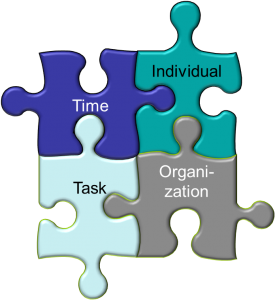
First of all we need to state like in jurisdiction: It depends. Namely it depends on what might me the reasons why a project is not performing as expected. There is rarely a single cause but usually a mélange of multiple factors which can be clustered in the influences of time, individual, organization and task. To explain very shortly these are problems that derive from time conflicts in project management, skills deficits at the project manager and his team, insufficient interplay between project and organization and within the organization, and from unclear, changing or very complex objectives. And they very often are not at allnew but rather trivial, and therefore so very unnecessary and actually not difficult to resolve.
The issues are not the main problem
What make the recovery of distressed projects that difficult are rather the root causes, why mistakes are made, than the mistakes themselves. Unfortunately this is also the reason why people often try curing the symptoms then, and waiting for self-healing – with fatal and expensive results. To think that you can find out of the crisis with the same (cheap) measures that have led into it is a preferred self- deception practice then!
To prerecord: the topic organization participates in at least half of the cases in the problems that projects face. That’s why it does not make sense to pin the project manager to the wall then or to challenge the team for increased commitment. The problem mostly cannot be solved by the project or within the project! And it therefore then needs for resolution peculiarly a different support from functional and central departments, and in most cases by the management, too.
Without management’s will for recovery all efforts are in vain
I have seen a lot of projects in distress. Most of them I could help to achieve a return on investment and a business benefit instead. And those had one thing in common: they were recovered driven by the management in the same determined and consequent manner as the management would have done if the company itself were in distress. This by the way also proves how important an organization’s acknowledgement towards its projects is for their success.
My expert advise for recovery
From this long experience I’d like to recommend:
Have the courage to admit that your project is in trouble, and that it needs help because it will not get back on its feet by own means, or at least unjustifiably slow. As a project manager escalate forcibly, as executive in charge act determined and responsible. A cancelled project is worse for the company and the career than a successfully recovered one!
Waiting burns money and trust! Therefore act early, i.e. before the project is right in front of the wall (milestone, penalties etc.). The earlier you recognize and tackle the issues the smaller your losses are. And you have more options for measures or negotiations as well.
In most cases there is already help in objectification of the situation. Where positions are stuck and block progress they have to be resolved to serve again the interests behind. But many times this is no longer feasible without an impartial third. Anyway before that is done by lawyers and a court you should better make use of the neutrality of an expert assessment which is paid by all parties alike.
Every recovery needs to provide a balance of interests. The barn door is closed after the horse escaped, the business case will probably not be met as planned – for none of the participants. However a cancelled project doesn’t provide value to anybody! That implies you need to look for cooperative resolution approaches that serve all interests in a “perceived fair” manner. The impartial expert assessment is the basis for such new agreements and measures.
Success will only come with collaboration of all parties. It might not be as trustful as at the project‘s start, but that can be compensated with neutral audits. If with the help of neutral revision, mediation and control you succeed in overcoming the road blocks you will also succeed in completing the project halfway acceptably, and therefore safeguard ROI and benefits. A strong project management expert, competent in social and methodology practice, will leverage in consequently implementing and executing the necessary measures while also leading the organization besides the projects to success (the emphasis on leading!) to draw on the mistakes root causes as well.
Sustainable change for prevention
That way the first important step is done to improve project management’s esteem also within the organization. To prevent a next, similar disaster executives need to address the causes and invest in their project management’s quality, which means, besides education, at many companies peculiarly a Change Management on corporate level regarding their project organization and culture.
Get yourself independent help
From my statements you can also clearly read a summation to make use of an impartial third, i.e. an external, for the expert assessment and project recovery. They don’t necessarily need to be subject matter or industry experts. There are probably enough subject matter experts in the project team. Was is lacking in nearly all distressed projects is an expert in project management with bold leadership qualities, because he needs to be able to lead not only the project out of the crisis but also its environment. And because that evidently failed by own means you have to hire an external project recovery specialist.
In addition an external is per se rational and neutral, what can be underlined by jointly mandating him by all parties. It is also important that an external can address things open and frankly, even things which wouldn’t be said this way from the internal career ladder to the respective addressees. But every detour is additional loss in time and money, and that’s something no project in distress can afford any more.
And finally because I know how it works !
Are you in charge of projects – in a project leader or management function? Do you experience projects which do not run as planned, are in a crisis situation or out of control? So what are you waiting for, then … ?
Have you ever experienced disputes with one of your customers or suppliers about the status and / or settlement date of deliveries, and/or about who is responsible for the deviations from the initially planned ones? This situation actually is not very unusual, and the possible causes are as diverse as the possible developments which can result for the project, wanted or unintentional. This is where a Project Revision and Recovery (if needed) can give clarity.
A case from my professional practice:
The case which I would like to describe to you today it was about a software development project for a Portal. A contractor was to supply the portal as a subproject for a general contractor. The GC was to set up the back-end system for the customer.
Because the Back-End is a proprietary system, the portal development had to occur in the GC’s programming environment. This, however, had some flaws with regard to performance and availability, and also was incompletely documented. The subcontractor had read through and agreed on the task description, but has overlooked the fact that he was responsible for requirement assessment, the specification, and the verification of the deliverables with the customer. He also did not realize that the development environment was completely unknown to him when signing the fixed price contract. A somewhat careless risk management and lack of communication pushed everything over the top, until a milestone came up that could be neither kept nor eased.
In such a case you can imagine the resulting scenarios; in particular when the parties are stuck in mutual blaming, the customer is insisting on the deliveries and is threatening with penalties. Once the attorneys get to the table, such a project can easily topple over completely. At the very least, it then becomes ugly and expensive.
Independent expert assessment instead of remedy at courts
However, prior to practising system development through lawery, the parties had thought better of it and called me as an external “impartial” to do an audit of the project in order to achieve a safeguarded status, critical fields of action and some insight on the chances for a successful completion, on which further negotiations could be based. Note: an audit is supposed to be a matter of solutions, not of finding someone guilty!
Usually the findings are not clearly at the expense of one party, as was the case here, but the details would lead too far here. It is, however, essential, that after having come back to an objective view on the situation and identifying the real problems to be solved, we were able to draw the overall project out of the danger zone with appropriate solutions and agreements, with only minor bruising to the business cases.
Not a solitary case as experience shows
While in this project the Gordian knot could be broken with an objective situational analysis and some, albeit painful change requests, in other cases it is often the flood of project change requests that lead to additional costs and finally disagreement. This variant is particularly popular where enterprises or authorities, inexperienced in the project topic (for example implementation of a specific IT system), and consulting firms need to work together. These are also situations where I have been able to help by clarifying and mediating with an audit of the project, the contractual obligations and the project management processes. To an experienced and independent Project Management Professional the pitfalls and weaknesses are quickly recognised, and he can contribute to a solution and to lasting preventions.
Preventionand continuous improvement
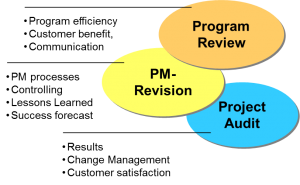
Smart companies, however, do not wait for crisis situations to be driven to ask for external help. They practise a pro-active risk management and regular project audits. With the regular measurement of project performance against the project goals and the frequent inspection of the application of appropriate PM methods, tools and corresponding rules an impressive project quality assurance can easily be performed, which quickly translates to strategic advantages such as customer and employee satisfaction. If the resources or specialists really should be missing for this purpose, it’s still time to call for (temporary) external help…
In my article this year in May (Why projects in distress are rather written off than recovered) I described my impressions and considerations about restraints to refer to neutral and competent help in distressed situations. Failure culture is actually one of the main causes for distressed Projects and especially for ongoing or repeated project crisis, and therefore subject of my article here.
Different treatment of crisis situation at companies vs. projects
When companies are in trouble it is obviously a matter of course to bring a crisis-proven consultant (“Turn-around Manager”) on board to apply leverage with his independent insights without mind cuffs and get the company going again. However at troubled investments and distressed projects, even if they are immensely expensive or strategically important, the accountable managers unequally do harder to confess the fact that they are tied up in dangerous waters which they are not able to get out by own means and their project management without significant losses. To all instants and purposes this seems not understandable, as a failed or cancelled project leaves no value to anybody; it’s just an expensive write off, isn’t it? Why then, with the same matter of course, don’t they instead ask an experienced external professional how to yet safeguard at least some benefits and ROI at the troubled project?!
After the broadcast of my article in October I received a lot of feedback and intensely discussed with many colleagues and clients. I now would like to summarize the results here, and to keep the discussion stimulated widely spread. Ideally I’d like to consolidate feedbacks here to provide the information to all participants and interested people. Therefore I’m happy if you adopt my stimuli from the various media and then use the comment functionality here for an intensive, multi-level discussion.
So, what findings about the treatment of projects in distress did I manage to collect?
The reasons for serious problems at projects as a matter of fact are usually of a quite simple nature. What seems to be trivial for my as an expert, is obviously a widespread mystery in practice: Always and everywhere it’s the same, well known, basic mistakes that happen. In certain melanges they then lead to the calamitous vortex that threatens the project to be absorbed. And those who steered it into this situation probably won’t find the way out – if they had seen the peril they obviously wouldn’t have gone there at all !
There are cultural differences dealing with the crisis situation. American/English owned companies tend to react much more willingly and faster to analyze, pinpoint and eliminate the causes than German companies do. In Germany the loss of face seems to outweigh the economic success – very irrational and expensive !
For the same reason the former also ask for competent, external help much more early. If you don’t have the competence for resolution in-house you simply buy it. That’s more efficient and effective, and as we know just in crisis situations time is money !
Corporations behave different compared to medium-sized companies. In big organizations project management processes are increasingly mature and well documented, consequent application however depends on the project manager’s individual qualification and the management’s priorities. When problems appear often responsibles‘ first look is on their own careers. Issues are dismissed, whitewashed or not reported more often. In case of doubt they look for a scape goat, if possible not at the own department. Management frequently is not involved enough, learns late about the problems and decides to consequently take countermeasures even later. Because of the companies‘ usually strong financial backgrounds projects are more likely to be cancelled and written off; some do simply fade away if not driven „top-down“.
In medium-sized companies management mostly decides faster and more consequently – well, it matters to their own money. Having not enough corporate PM capacitiy the project leads have (too) many projects to look after in parallel and are deeply involved in functional work on top. Project Management as a discipline is rarely mature and well-marked. Moreover established corporate culture and a market position free of sorrows for decades have often built a very functional, product oriented way of thinking, in which the management often has not yet properly anticipated their operational roles in their projects. External advisors are said to be too expensive, to have no clue of the company’s individual business, and to be be a potential leak for corporate internal affairs. Here it’s more the jeopardized halo of the patriarchy that leads to long lasting hope for self-healing and prevents efficient and effective solutions.
At public authorities in many countries problems mostly are pre-programmed „in the system“. Processes and instructions for solicitation and seller selection, like German VOB, are pre-defined in nuclear detail; after that projects are expected to strictly follow the contracts. Project management often does not exist at all or is limited to coordination without authority; mostly it is also contracted to the supplier. The faith in regulations washes clean from all insufficiencies outside the rules and blocks self-reliant initiatives for improvement. It really takes a very prominent “bad case”, highly political and too big to die, and a very prominent external savior from the political environment to make a significant setting the course happen. Let’s not examine his own competence to recover distressed projects…
Projects at corporations and public authorities also often suffer from insufficient staffing of the project management positions. To simplify and rationalize the supply chain they prefer to depend on “preferred sellers” or even contract only with the big (and expensive) consultancy firms – without distinction of the hired resources’ effective quality. Procurement’s price lists and provider’s frame contracts rarely leave enough range for adequate project management staffing. Many responsible department leaders therefore need to put up with what they get for small money – even in distress situations !
Distressed Projects recovery is (almost) always beneficial
But nearly all troubled projects and investments have one thing in common: With a small effort and a little bit of impartial support they could be led to a reasonably successful result – much cheaper than if continued as is ! Bringing project partners stuck in positions back to objectives, and achieving agreement on cooperation with concrete, expedient measures would already be „half of the rent“. Within the project there is mostly the willingness to proceed so, the openness has to take place in the accountable management’s heads.
Now it’s your turn. What, in your experience, are the biggest road blocks why projects are still rather written off than recovered? Write your comment, provide your input about the causes for distressed projects to a discussion of which we all can learn and profit !
As a reaction to my recently published IT case study I received many mails which confirmed my experiences and asked for more examples. That doesn’t imply representativeness, but it shows that such cases are not the exception. Together with representative research about Project Management like the Standish Group Chaos Reports or PMI’s Pulse of Profession we can imagine how much money is burned repeatedly in badly managed projects. Totally unnecessary, as again shown in the following case from my practice:
The case:
An SME plant engineering company, after decades of uncontested market leadership, faced a growing low-price competition from foreign countries since some years. The order books were still well filled; the firm was comfortably equipped with private capital. Still customers increasingly discussed prices and didn’t accept delays at the contract fulfilment any more. The company had invested in several R&D projects for retaining technology leadership to differentiate from the price fight and to decrease product costs. Most of them were far behind schedule and over budget. In addition clearing and settlement of contracts were slowed down repeatedly in own plants, at suppliers and during installation.
The management already had engaged a number of consulting firms to perform rationalization and process optimization projects. But it took until a key product development project with a schedule delay of 1½ years was jeopardized to completely loose its time-to-market and therefore its ROI that management determined to conduct a project revision and recovery action.
My expert assessment’s findings:
After roughly four weeks my diagnosis was firm. This is the short version:
In product development top-class engineers were working in multiple projects at a time, led by chief engineers who had special expertise in the specific development field, but did the project management by the side and without explicit education. Their focus naturally was on the technique; problems seemed solvable as long as time and money did not matter. In the Steering Committee there was no agreement on priorities of the goals “unchallenged technology” vs. “product cost cuts”.
Instead of giving direction by decisions, they issued increasing caveats, and swallowed increasing surplus cost for a long time. In the projects development phases and prototypes frequently were delayed, personnel and machines for tests and dry runs were ordered, cancelled, and then were not available for the new dates, etc. “Lack of resources” was the prevalent opinion, but in fact there was a lack of leadership and of a reliable planning and control, spiced with overload and inefficient multitasking.
With a clear, unambiguous scope many tasks wouldn’t have led to conflicts, the majority of the tests could have been conducted in the laboratories prior to building expensive prototypes, and thus could have eliminated a lot of reservations and risks upfront. The Steering Committee could and should have intervened much earlier if they had had a proper reporting and a sense for their own project responsibility.
The complete lack at all levels of project management and understanding for project roles in R&D prompted similar deficits at the company’s delivery projects.
Root causes are in the corporate project management culture
The project leads there had the difficult task to coordinate the assembly in the P&L responsible plants, the shipping, and the installation onsite at the customer without having real competences and access to resources. Sales, driven by commission interests, often threw badly cleared orders and unrealistic delivery promises over the fence at the projects. At the installation sites, in particular with international orders, regional sales interests, mentality or working habits frequently spoiled fulfilment to plan. Suppliers and customers often had a weak organizational maturity to achieve provisions as planned. Thus many projects were “deeply red” already at order confirmation; the involved units’ own lives prevented from targeted project management, and their individual striving for profit made an overall optimization of project margins impossible.
The conclusion was that in both areas not the project leads and teams were the root causes for the misery but insufficient sensibility and recognition for project work and management in the entire company. Besides recovering the R&D key project I therefore had to initiate a successive change in the organizational project culture, away from functional thinking in products towards a holistic customer focus in a project-driven business. (This btw. nicely shows the strategic business component in my professional work …)
The first could quite immediately be managed with some organizational measures, some fundamental decisions about the project’s targets, and a little grab in the project management processes and tools box. After roughly half a year the project was completed with a marketable result; a follow-up project was initiated to further improve the technology.
The project’s distress total balance:
Delay ca. 8 FTE x 1,5 man years = 650,000 Euro
Effort until completion another 8 x 0,5 man years = 200,000 Euro
Effort for revision and recovery ca. 30,000 Euro
or in other terms
Surplus cost in total ca. 880,000 Euro (planned budget 750,000 Euro)
Revenue loss ca. 200 units not built/sold in 1.5 years = 60 Mio. Euro
The company’s “cultural change” is still going on, after management had struggled hard to acknowledge its necessity. Culture is something that has grown and is established, habits of thinking and acting cannot be changed that easy. But if there is to be profit again in the corporate balance instead of a red Zero, if with customer orders (= projects) profits are to be made instead of only turnover, then this effort is a strategic imperative and economically reasonable. To wait would mean to further lose money and market share.
Imagine a company gets into distress, writes losses for a long time and is threatened to fail. What would a responsible entrepreneur or manager probably do to avoid insolvency? He acquires counsel from experts, purchases a restructurer, tries to save what is left, the turn-around. How about Project Recovery…?
With distressed projects it’s totally different
Now imagine the majority of troubled projects, which write massive losses, exceed their schedules by far, are threatened to not meeting their objectives and to be written off. What will many of the managers in charge of these projects do?
Having to admit failures is the biggest obstacle to rescue
First of all it is hard for them to admit that not only the project lead and the team but they themselves have a problem. To hold someone guilty and consider it a question of commitment and effort is the easiest conclusion. To whip on the crew is the most obvious, but mostly least sustainable resolution approach, because short-term performance peaks will usually be followed by higher illness absences and demotivation.
Ignorance and fear of transparency also keep away from recovery
Many managers also shun the transparency of their own responsibility, may be are too far away from the course of events at the project due to a lack of control and communication procedures. Or they seek the causes primarily in technical/professional problems, not in the way how the project is conducted. Well, on executive level project management often is considered to be a commodity, something e.g. every well skilled engineer should be able to do as a sideline. Does he, and does he want to do it, or will he rather naturally turn back to and concentrate on the subjects he knows best when things get rough, and the “unloved” project management will suffer?!
Problems hardly solve themselves
And that is how in most projects in distress all hopes are on self-healing, and they wait too long until the situation is really messy. An expert assessment or project recovery as a resolution approach is fairly unknown to many managers or unimaginable. In many cases a total write-off of the sunk cost and the desired business benefit is preferred over involving the management early in responsibility and purchase an experienced restructurer – from external, because it is proven that internally there is no working resolution at hand. How could this person cost a fortune compared to what will be burned if the project is continued as is or even fails?!
The earlier you act, the bigger the chances
The lines above only describe the “general” part of causes why troubled projects often get to where they are. In addition there are actually many industry or project subject specific reasons which I come across in my expert assessments all over again. It is obvious that the chances for project success and return on investment in a project recovery are the bigger the earlier the management determine to do this step. That leaves finally to appeal to them to decide near-term and responsibly !
What are your experiences with this? Join our discussion and enlarge upon the topic. I’m looking forward to your comment.
Great things coming are casting their shadows before. Accordingly I would like to call your attention already now to some important changes in my service portfolio.
The last years have shown that my experience and expertise have been increasingly occupied by expert assessments and recoveries of troubled projects and programmes. This leaves too short time for a broad service portfolio.
That’s why I have decided to even more concentrate on my very special area of expertise. For the many other cases where there is a need for experienced and professional project managers I have expanded my network “PM-Professionals” significantly. All current services will be continued for you under this label and my quality assuring supervision.
The changes will also be reflected in my Internet presence which I’m currently redesigning from the scratch. It’s therefore also time (and for you a final opportunity) to say Good-bye to my “old” website and its broad overview on my service portfolio. I will inform you in time in ca. 2-3 weeks about the launch of my new sites.
Thank you for your past confidence – I’m looking forward to the many great things which I get to go about with you !
Wir verwenden Cookies, um unsere Website und unseren Service zu optimieren.
Funktionale Cookies
Always active
Die technische Speicherung oder der Zugang ist unbedingt erforderlich für den rechtmäßigen Zweck, die Nutzung eines bestimmten Dienstes zu ermöglichen, der vom Teilnehmer oder Nutzer ausdrücklich gewünscht wird, oder für den alleinigen Zweck, die Übertragung einer Nachricht über ein elektronisches Kommunikationsnetz durchzuführen.
Preferences
Die technische Speicherung oder der Zugriff ist für den rechtmäßigen Zweck der Speicherung von Präferenzen erforderlich, die nicht vom Abonnenten oder Benutzer angefordert wurden.
Statistiken
Die technische Speicherung oder der Zugriff, der ausschließlich zu statistischen Zwecken erfolgt.Die technische Speicherung oder der Zugriff, der ausschließlich zu anonymen statistischen Zwecken verwendet wird. Ohne eine Vorladung, die freiwillige Zustimmung deines Internetdienstanbieters oder zusätzliche Aufzeichnungen von Dritten können die zu diesem Zweck gespeicherten oder abgerufenen Informationen allein in der Regel nicht dazu verwendet werden, dich zu identifizieren.
Marketing
Die technische Speicherung oder der Zugriff ist erforderlich, um Nutzerprofile zu erstellen, um Werbung zu versenden oder um den Nutzer auf einer Website oder über mehrere Websites hinweg zu ähnlichen Marketingzwecken zu verfolgen.


 But there are also successful exceptions where the boss feels bad for the burned money, and lionhearted requests advice from external experts. If he does early enough there is mostly hope for project success and a gain of lessons for the future.
 The issues are not the main problem
 Waiting burns money and trust! Therefore act early, i.e. before the project is right in front of the wall (milestone, penalties etc.). The earlier you recognize and tackle the issues the smaller your losses are. And you have more options for measures or negotiations as well.
 Not a solitary case as experience shows

 The case:
 onsite at the customer without having real competences and access to resources. Sales, driven by commission interests, often threw badly cleared orders and unrealistic delivery promises over the fence at the projects. At the installation sites, in particular with international orders, regional sales interests, mentality or working habits frequently spoiled fulfilment to plan. Suppliers and customers often had a weak organizational maturity to achieve provisions as planned. Thus many projects were “deeply red” already at order confirmation; the involved units’ own lives prevented from targeted project management, and their individual striving for profit made an overall optimization of project margins impossible.
 Having to admit failures is the biggest obstacle to rescue