
Assign scarce resources to multiple projects in the pipeline following priorities given by the company’s strategic objective framework. Adapt long runner projects to changing environments and requirements to achieve maximum benefit from resource allocation. Not primarily deliver products and services, but by these deliverables prepare and enable the organization for capturing sustainable and strategic benefits. That’s the added value that is behind competent Project Management,
Project Management is the matter of the Management
Where does project and multi project management end, and where does programme and portfolio management begin? Where is it appropriate for executives to delegate simple projects as a “commodity”, and where is mature project, programme and portfolio management in the very responsibility of the top management? There are still wide gaps between project handbooks, corporate project culture, and project and enterprise leadership.
 Science and management still need to realize and acknowledge that besides manageing the daily business there is another, meanwhile similarly important area of leadership which, by investments and initiatives (= projects and programmes) prepares and adapts the company to the market requirements and future. Then there is a chance that the added value deriving from this area is valued appropriately enough to be managed as professionally as the running business, and thus is able to achieve better success ratios and meet targets better than it is until now.
That similarly applies to crisis management
I’m also curious when it will be that the business value of organizational project management will be acknowledged by the C-level in a way that allows recovering troubled projects as consequently as it is done with companies in distress. It would mean million wins with ROI and time to market for companies if the management would set priorities right here as well and provide help to projects with wrong set up or staff early enough, instead of wasting and burning employees, resources, motivation, trust and a lot of money by waiting, pressure and hope for self-healing.
Learn more about the topic at the key word Project Management Business Value
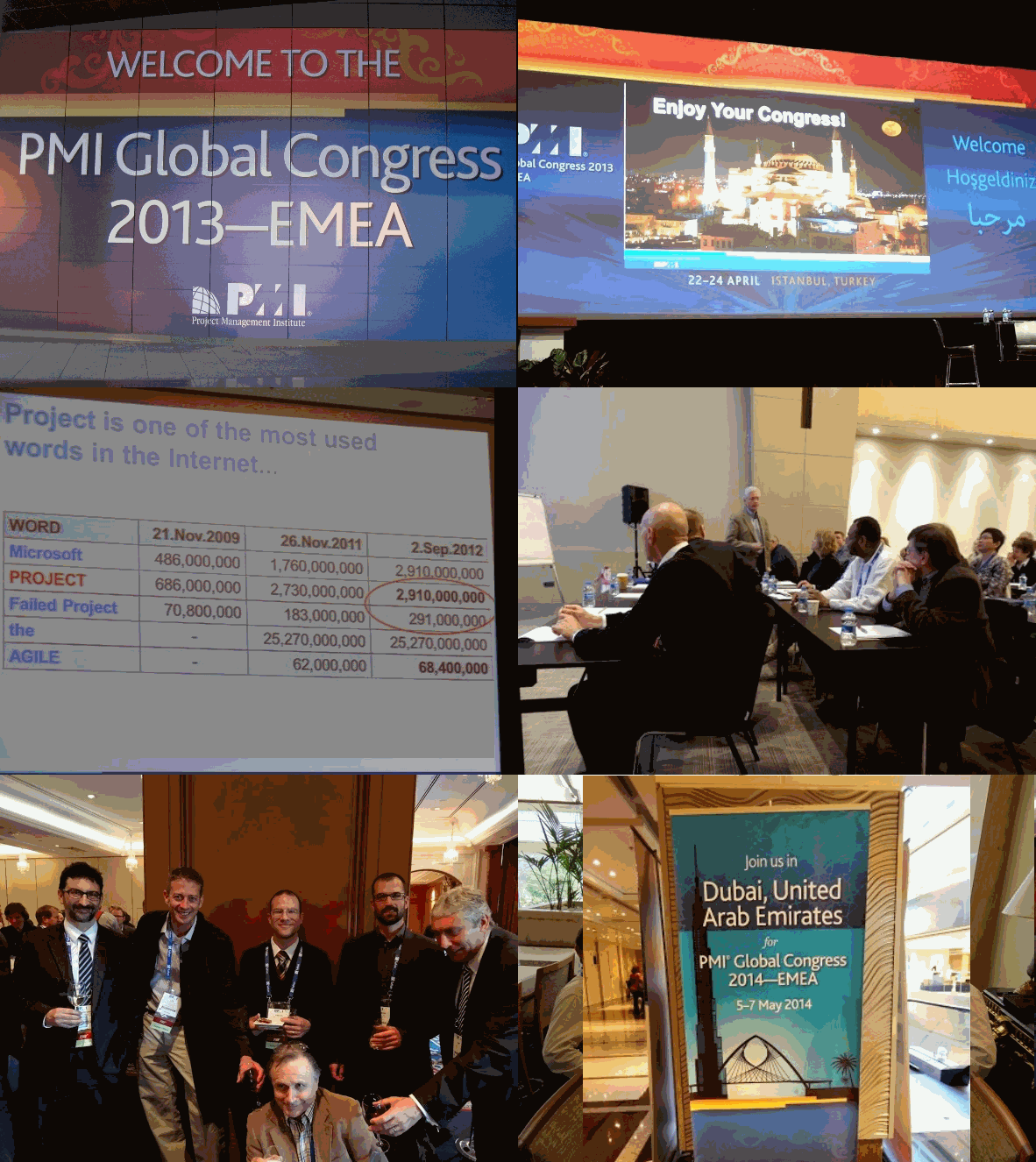 As always orchestrated perfectly by PMI the congress days flew by. The PMI obviously is very much interested in the emerging markets in MEA as many presenters came from here, and also the slide decks’ contents often dealed with PM basics – from PMPs for for PMPs and those who want to earn the credentials. Thus unfortunately the more sophisticated topics like programme and portfolio management were underrepresented to my liking. Nevertheless I had the oportunity in discussions at the spreaches and in dialogues with more senior colleagues to intensify the topics a little more “academic” several times.
 It also shows that the success ratio of projects is decreasing again since 2008. Fewer than 2/3 of projects meet their goals and business intent, and about 17% fail outright. This means in plain figures that from every $1 billion of project volume $ 135 Mio. is burned money, not yet counted the collateral at business benefits like missed market opportunities, bad efficiency, losses at the bottom line etc.. But the research also shows that companies with a “mature” project organisation manage to realise their project objectives and benefits at 90% on average, whereas such that work in a “do more with less” business environment only achieve in 34%.
 Through the years my advisory focus has changed to Project Management. My assets of experience from good and bad examples has grown, complemented and methodologically supported by Best Practices from internationally acknowledged PM standards. My basis for successful Project Recovery…
 This is only a small selection, and the many variations, facets and combinations are always fascinating for a project expert, and their seemingly Godly driven repetition in so many projects is startling. How much money is burned in that way – no project manager in the world can cost that much…