
The Center for Business Practices (Havertown, USA) conducted a survey in April 2006 with 84, mostly USA based project managers in 3.874 projects. The companies had average project budgets of US$65 Millions per year. 47% of the projects got in trouble, were recovered or were cancelled. These are the most frequent issues in troubled projects, i.e. their main symptoms:
- Critical problems in reaching milestones or completing deliverables
- High risk that the project will not achieve the expected benefits
- Project’s completion will be unacceptably delayed compared to schedule baseline
- Critical or significantly increasing technical issues in the project
When being asked how to recover the project, project managers in 24% of the companies answered there is a standardized process for project recovery, in 31% of the companies there is no plan at all for this situation…
Another CBP study at 16.110 projects with a total value of US$29,8 Billion showed 7% were completed with more or less difficulties, 25% stay troubled until the end and 6% fail completely. And 33% of project expenses go into self-managed project recovery or measures to compensate project mistakes’ impacts.
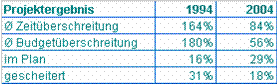 A Standish Group (CHAOS Research 2006) research nearly confirms these results: 46% of troubled vs. 35% successful projects, but also 19% failed initiatives. There seems to be a tendency of improvement in the recent years thanks to better project manager education and implementation of project supporting structures within the organizations.
This proves: investing in professional project management pays back in the end against the biggest issues in troubled projects !
Read more about this topic – click here …
 Although this survey only covers one industry sector the “misuse” of project managers also in other industries for tasks not belonging to the profession, especially in technical contributions and business development, appears to be the rule rather than the exception. This might also explain why many troubled projects significantly improve when the well skilled, but overwhelmed by “PM on the side” project manager is relieved by assigning an additional project manager who is dedicated to deal exclusively with the management of the project (including the project’s recovery).