
Sometimes it takes a little longer to discover a relation. That’s why I like to store this article with my personal Lessons Learned. Already in a very early posting I asked my readers why it is so difficult to “sell” good project management to Executives. One reason might be that people – managers, too – actually understand different things with the terms “project” and “project management” dependent on their so far career path. On the other hand, that’s also why so many call themselves “project manager” without ever having managed a real project.
Examples to understand projects’ nature
The following examples should help managers and project leads to better understand their project’s “nature”, and thus take a more target leading approach for their project management.
Example Automotive: At the big automobile manufacturers a car model (e.g. the VW Bus) often is called a “program”, its sequential model series (T1, T2, …, T6) then are “projects”, which actually run until the type is substituted by the next one. This is in contradiction to the “official” project management definition and DIN/ISO 21505, where a project’s characteristics are having a defined start and finish, 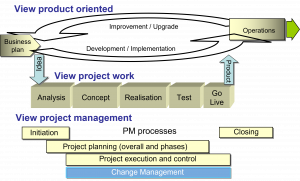 and during this time developing something new and unique (product or service). That’ when the project is done. The term “project” doesn’t include serial production. But this doesn’t keep their suppliers neither from adapting their OEMs’ point of view when developing and serially producing their components.
Another example is manufacturing by order, where components, accessories or the packaging are developed to the customer’s specifications, and then are produced in bulk. For these “projects” mostly proven process models exist, which exactly describe the distinct project steps in their sequence and content, and by which “forgetting” important work steps is prevented. Serial production is out of a project’s scope here, too.
What is it now, a project !?
The, following the above-mentioned project definition, characteristically innovative part of the project here is reduced to the tasks that adapt the product to the specifics of the new type or customer product. The project definition does not even foresee an ongoing production; which is rather reserved for program components or operations. In the examples above however, the product’s serial application or production usually is the main part of the “project”.
To make it clear: The guy widely known from do-it-yourself advertisements who, with the help of his DIY market, “does his project” truly conducts a real project according to the definition. He has reserved the weekend for it, he plans his activities and materials, he executes the tasks, and in the end he has achieved his “product” – new, unique, period.
How mistaken project understanding drives many Executives to not assign true project managers
Back to our industry examples: “Miss-used” that way such “projects” mostly get a kind of functionally focused “project management”. This means it is usually a very experienced engineer who knows the approach, work steps, tools, materials, suppliers etc. well, and primarily controls the execution.
 There is very few focus on skills or an education in what I understand with project management, i.e. professional handling of uncertainty, risk, changing scope, schedule and cost planning, team building, team and supplier coordination, communication, leadership etc., actually planning and controlling the project. It seems to be not critical or necessary in this kind of fairly controlled environment, or it is thought to be easily done “at the side”. In many companies there is a technical lead responsible for this kind of work, and the project managers often care for many projects in parallel.
It is an even ignorant project understanding what I unfortunately not rarely happen to meet at the C-level as well: “We hire someone for X amount of money and assign him to some projects. For that salary he should probably be able to manage them!” I wonder whether selection and expectations towards managing the company is the same when hiring a General Manager…?
That’s why delays and cost increase are rather referred to technical issues instead of possibly insufficient management of the project with lacking overview, control and leadership. And therefore the Executives of these companies don’t realize how they would benefit from such skills at their project managers or from “true” project management on top of simple “execution” by the technical project leads (meaning double heads) in terms of project cost savings, time-to-market and ROI.
Not an issue in single industries!
Even in companies whose core business actually is „definition compliant“ projects recognizing this is not really common: In consulting, software development, machine and plant engineering or even in R&D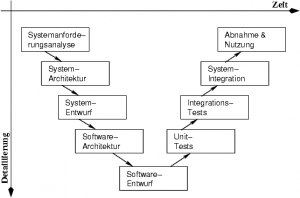 creative activities are necessary besides technical work. Therefore the presence of uncertainty and risk is incomparably higher, exchange of ideas, team communication and collaboration are critical success factors.
Unfortunately also in these industries process models (e.g. Sure Step and ValueSAP/Solution Manager) or Standards (e.g. V-Model, PRINCE2 and ITIL) lead to believe being in controlled environment. These tools and guidelines provide good and precious support, but do not substitute their proficient use with a sound understanding of the application area project management by a method savvy project manager. Because what’s the use of it for me if my project manager has followed Sure Step exactly but nevertheless has failed to keep his schedule and budget?!!!
Also relevant in agile projects
Hoping to get better projects finally, some managers proclaim the change to Agile. Only few of them are conscious of what agility means for the company and thus for the management level, i.e. the working agile in projects doesn’t substitute a expedient project understanding, and that it additionally premises immersing in and embarking on agile methodology. To let the project team organize itself with some Scrum artefacts, but then expecting a planning and reports with fixed milestones, deliverables, and budgets, this will fail in agile projects, too. Where projects are done agile also the management must be wired agile. Without a correct project understanding, and knowledge and mastering of the project methodology every project is doomed to become distressed!
That’s why there always must be someone who “full-time” keeps oversight, holds the reins, controls and leads the team: a project manager, who owns just these skills, and preferably has learned and trained them methodically. Functional knowhow should be secondary in this leader role and reserved for the specialists in the team.
Why professional PM is so important just now
Let’s conclude: It is an “incomplete“ project understanding and/or a felt security of tools which often lead Executives to underestimate the project management task and assign it to improper hands. This has serious effects, namely that still the majority of projects do not reach their objectives concerning time, cost and scope within plan or not at all globally, and that many returns are burned or investments are written off. To judge this phenomenon as being “completely normal with projects” may be self-excused at politicians, but should bring General Managers, Vice Presidents and members of the supervisory board to the scene !
 But what no statistics can show yet is the effects persistence of this misjudgment and denial will have in connection with the actual fast progressing digitalization and the related sweeping change in the market. Because projects are made to realize change by definition – and that should be approached professionally and responsibly!
 PMI members have already received mail, for all others it is available here: The new PMI Pulse of the Profession Report is out. Again it is constituted that companies with a higher maturity in project management have better and more profitable projects – seems to be no wonder. But different to the preceding years the study for the first time since five years has detected an improvement of meeting project objectives: “Only” 9.7% of the investment sum were “burnt”, that is 20% less than the year before!
 In Computerwoche Magazine’s issue of 12. June 2012 the authors Marcus Berger (Director EMM Consulting) and Dr. Thomas Henkelmann (Director Consulting Sevices, TPG The Project Group, München) write about Project Portfolio Management (PPM) and the pitfalls which come up for companies without a structured PPM. The article is in German.
 Four major root causes
 In one of my case studies (
 If you want to lead a project successfully you need, similar as in other professions, a good, methodical education which includes recognizing the specific project situation’s requirements and reasonably applying the adequate tools and techniques situatively and virtuously. That’s at project management like with craftsmanship where you find trainees, advanced and masters.
 Therefore a good project manager would not have undergone flaws like in our case because he would have taken care for a clear target and task definition from the start, and would have requested his superiors’ support consequently – for the sake of his project and himself. His planning would have based on realistic assumptions, and he would have identified and escalated risks and deviations and initiated counter measures early.
 To achieve he also needs another skill: leadership qualities. He is his project’s manager, responsible for the result, and he must steer his team and his superiors so that each one contributes his part to the whole. Not an easy task, in particular if the company doesn’t work project affine. And not everybody is the person for a leadership role, feels well in it. But if he takes his job serious he will apply project management including leadership consequently. Otherwise he will soon become a scape goat if the project fails. Not a very motivating perspective, or a subject for opportunistic PM nomads who sometimes call themselves project managers…
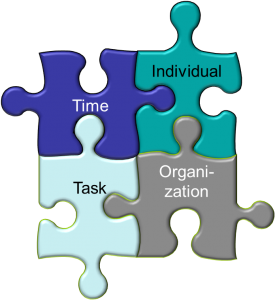
 Another frequent factor for troubled projects is time. I don’t mean the duration granted to the project for execution. This actually should always be sized realistic, not determined by wish thinking or arbitrarily. That means it must be based on realistic estimates done by the executing team members and taking the interdependences and frame conditions into account. Therefore “duration” falls into the category “Individual” for me, i.e. that the project manager does a competent job.
 In fact many statistics, e.g. the one at
  So the predominant part of project issues arises out of an insufficient support from the executing organization, which in turn is founded in the project culture, the management’s and established organization’s mindset.

 The PMI Pulse of the Profession 2016 (again) shows very clearly and easy to understand why project success, business success and good project management are directly interrelated: projects are 2 ½ times more successful (and profitable) when proven project management practices are used. It bases its argument this time as expected on PMI’s newly introduced Talent Triangle and stresses the necessity of interacting technical project management, leadership, and strategic and business management for corporate success.
 To quickly find effective measures for recovery it takes much experience in rescuing distressed projects: proficient identification of the main reasons and corresponding adequate measures.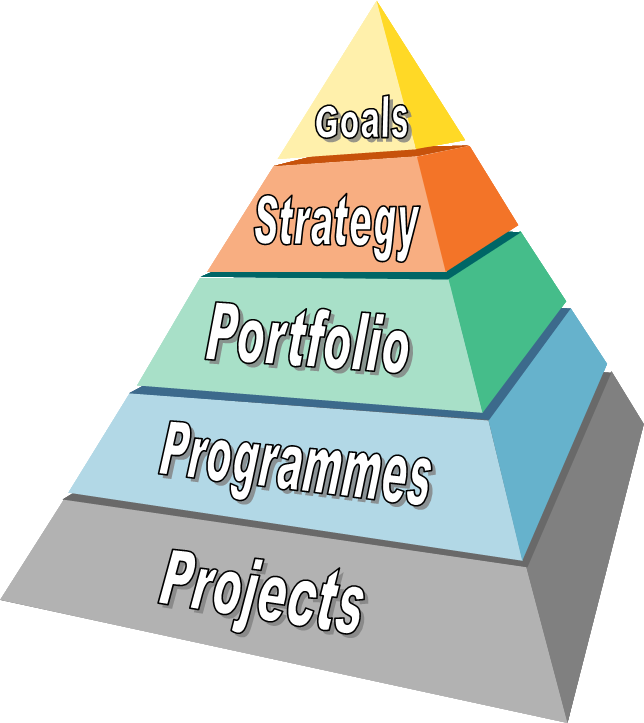
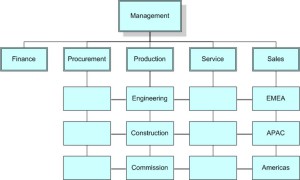 The organization no longer fits to its market
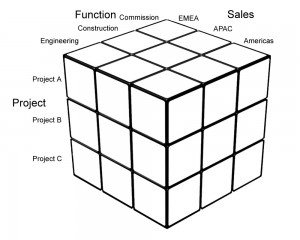 There is only help in a transformation of the organization and corporate culture concerning established hierarchies, responsibilities, compensations, thinking and priorities etc. towards an organization focused on the project business. In a pure line organization this means the change to a matrix “function vs. project”. At an already matrix-organized company it will be the implementation of a third dimension on peer-level to the existing ones. What it takes and what to pay attention to I have described in my article “