
Once upon a time before the rise of the millennium, when the word Scrum wasn’t invented and the Agile Manifesto wasn’t written yet… Maybe then my today’s practice retrospective isn’t completely correct in saying “it recently happened”, but I had similar project situations over and over again in the recent years where the case of hybrid Project Management told here is exemplary for.
Near to the standard but completely individual – is that feasible?
The case is about a pilot project for an ERP template which should be rolled out to all subsidiaries of a worldwide operating company subsequently in follow-up projects. To minimize the cost the template should keep near to the standard application, but yet it should also adapt market specifics, tax and legal requirements at the subsidiaries as best as possible. Squaring the circle?
So it turned out to be as to be expected: The Statement of Work (SOW) was frequently adapted to change requests for new or changed requirements from the branches, the headquarter departments took this as an invitation to generously insert their special wish list, too, and the forecasted cost blew all budget limits. Thus the project did what pilots always do when they do not receive a landing permission: it looped.
Agile and “classic” project management form a symbiosis
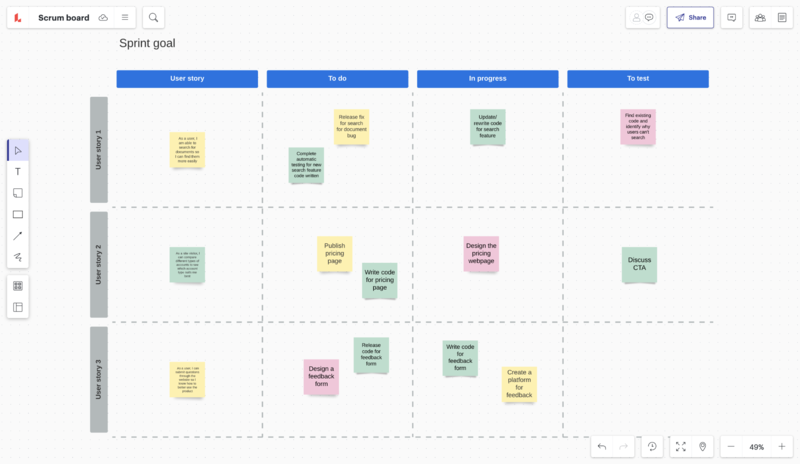
To get the project out of its requirements analysis and planning phase towards realization we decided to proceed iteratively starting with the core functionalities of the standard product. We agreed on a strategy to have complete and tested template ready to use within a certain span of time. This should be complemented and enhanced by prioritized increments subsequently until either the time and budget frame was spent or the template had sufficiently met the customer expectations.
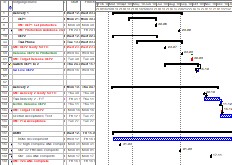
Accordingly our “classic” project planning contained framed time and budget boxes, so called “control accounts”, which the management could use at all times for reliable forecasts to have safe a calculation and planning. We even were able to forecast quite precisely by the priorities when we would be able to submit what functionalities to the business lines for testing, judgement and approval, which in return gave us stability and confidence in development and well-disposed stakeholders for the project.
The achievement: Quick Wins, flexibility and safety
That way we got two achievements: First we could start development without further delays, i.e. without having to wait for extensive detail planning as the standard and the unquestioned basic functionalities in the first development phases (sprints) were already clear and fixed from the beginning. Within five months we had a basic release ready to deploy which covered 70% of the processes and could serve to design the mappings for data migration from the legacy systems.

Second with this approach we kept the “quarrel of requirements” from the team to have it work undisturbed. Since then the discussion was done between the (called today) product owners from the branches and functional departments who needed to agree on a prioritized list of requirements (stories) and define a minimal SOW (product backlog). Later we found that we easily could develop individual market specific enhancements in “country backlogs” around a common core (the template backlog), of which the incremental release was dependent on a proper integration with the core.
Top efficient: agile on development level, “classic” on project management level
During the entire development phase the teams were only bound to what they committed to deliver “ready to deploy” within the 4-6 weeks release cycles from the top-down estimated and prioritized backlog pile. That worked well in 90% of the cases. Development was planned into traditional Project Management master schedule and budget as control accounts, risk and issue management closely cooperated with the team leads (Scrum Masters), project manager and quality managers (Product Owners) intensively with the stakeholders.
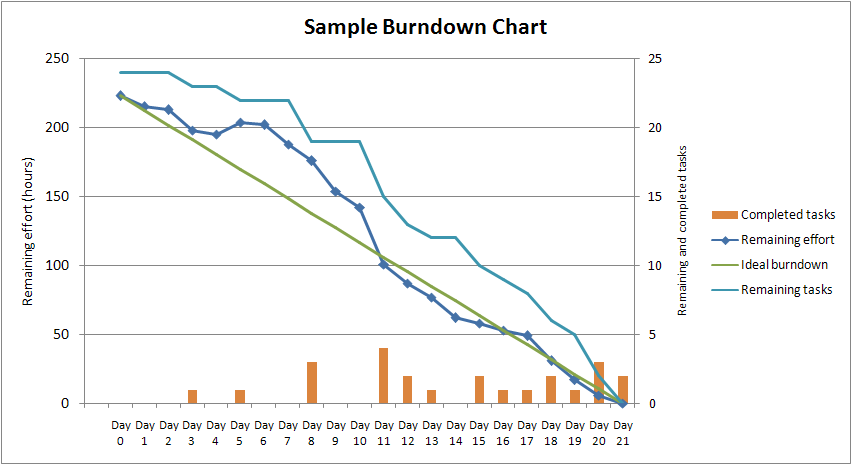
All in all we could save ca. 2 months of development after 18 months project duration. We preferred to invest this in a well prepared change management in the organization, at the expense of ca. 25% of the initial SOW that showed to be nice-to-haves and rather freed up capacities for new and judged to be more important requirements.
Additionally: We were live with the 14th template release months earlier than originally planned with the final product. Many subsidiaries had their variants already in operation when the initial plan would have started with the roll-out. In total we didn’t save that much on budget side but we won a lot at productivity and business.
An example of Best Practice
Why do I like to tell about this project? Because at that time we didn’t even know that many of our approaches were like today’s agile development methods. And because since then I found in many projects that agile and classic project management do not hurt each other. Coupled right and professional with each other they rather bear high productivity and efficiency potential that would benefit a lot of projects and business cases I see around…
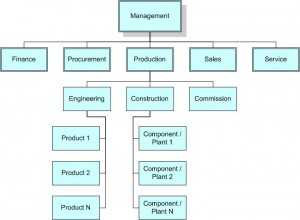 In Europe enterprises typically have an established line organization structure with functional and central departments. This is especially the case in our traditionally strong industries like Mechanical and Plant Engineering and in particular in privately owned, mid-size companies, but also at consulting and IT firms, engineering and development bureaus etc. Often I find a distinctive own life of the departments, production locations or plants with silo thinking, insufficient communication and cooperation. This becomes very evident with cross-functional work in projects.
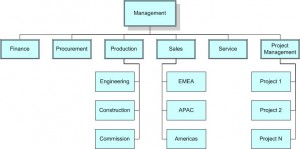 Project management as a core competency and strong department. Quit with functional specialists who lead the projects at the side. Project management needs full attention on planning, coordination and leadership – actually same as with corporate management. Time and objective conflicts of two hearts in the project leader’s chest are poison for concentrating on the essentials. His “thinking” also needs to be project-driven, no longer product love struck. Everybody contributes his core competence, the engineer his functional knowledge, and the project manager his PM skills, for success of the total. Process models and best practices make it replicable and calculable.
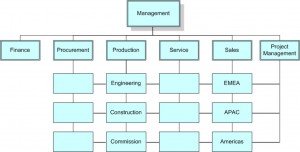 Functional and central departments as service providers for the projects. The previously gone through change in your corporate project culture will help you here. The engineers’ provisions will now not only serve for the product’s perfection but also for the whole task’s delivery to contract. Procurement will not only look at the terms and conditions but also (may be even sometimes with concessions supporting the project targets) at the reliability of delivery. Legal will probe partnership in collaboration; QM controls the project’s product quality and drives process quality (Continuous Improvement). HR will search for skills instead of positions, train for future project requirements, take care for a corporate identity among the employees, etc.

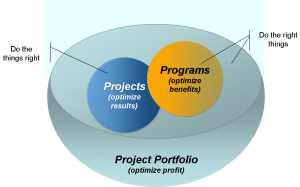
 Well, you won’t receive an assignment of responsibility for such a mega initiative if you didn’t show some real good performance and results as a PM before. But that’s insufficient in most cases for a programme if you are not familiar with additional PgM methodology and action to take.

 cost or mistakes’ causes, or even provide the opportunity of new revenues. The IT then is only a means to an end, shall support the professional process with adequate, automated IT processes. The added value doesn’t derive from the technics but of its application in the business.
 The only means against this dilemma is to sit and talk together again and again – business and IT – about the requirements and how to flesh out the realization. Business is in duty and responsibility that their connotations are picked up and understood correctly, nobody else! And this applies for the developers as well as for those who should use it in the end. This also requires the line department head – not the project manager or the IT – to manage his staff’s expectations.
 product, results or capabilities developed in the project.
 Those basics include: